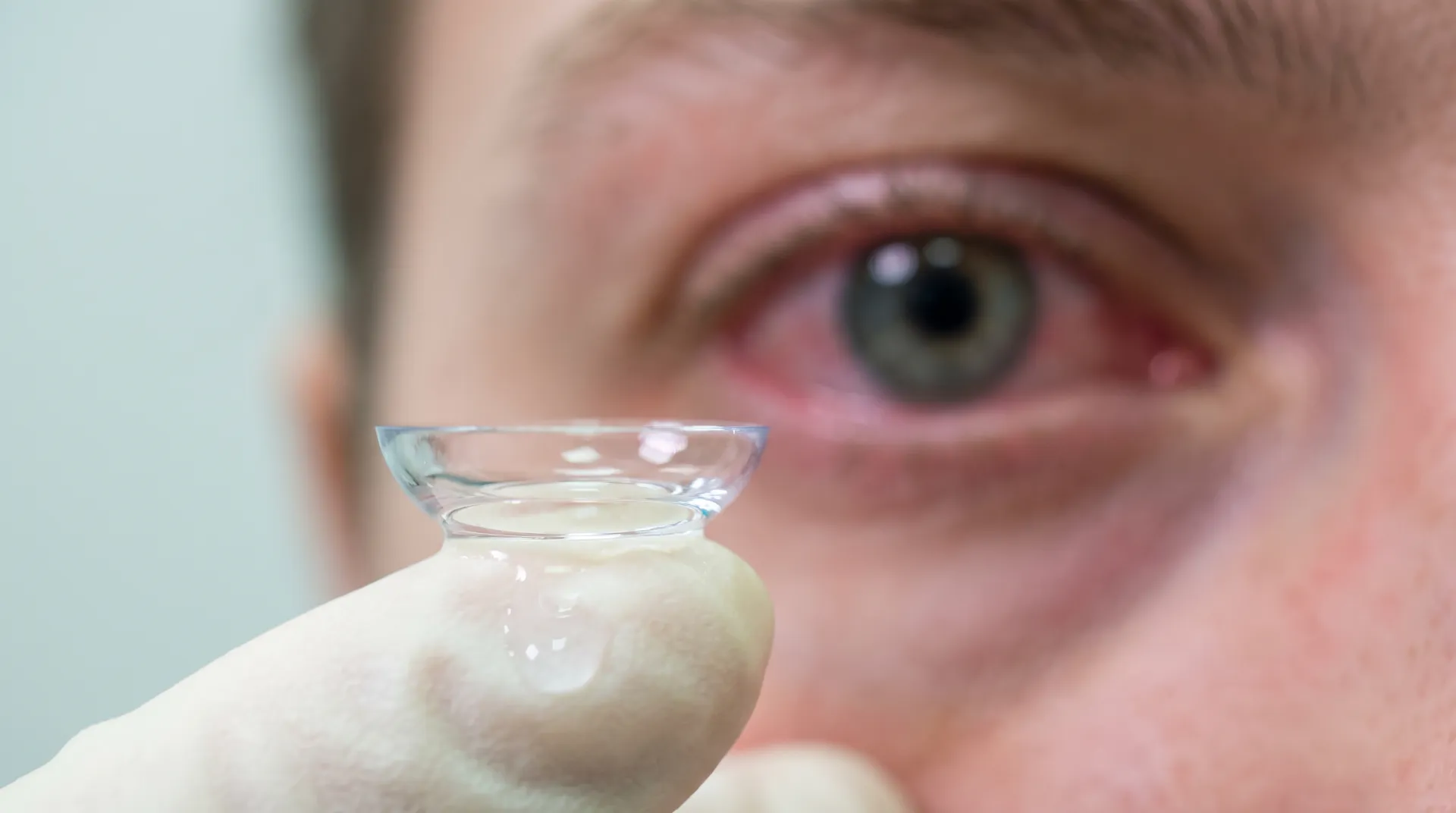
Scleral Lenses for Ocular Surface Disease
When drops, plugs, and medications are not enough, scleral lenses provide continuous corneal hydration and surface protection for GVHD, Stevens-Johnson syndrome, Sjögren's, neurotrophic keratitis, and other severe dry eye conditions.
Medically Reviewed by Dr. Alexander Bonakdar, O.D.
How a Scleral Lens Heals the Ocular Surface
A scleral lens vaults completely over the cornea without touching it. The space between the lens and the cornea is filled with preservative-free saline, creating a liquid bandage that continuously bathes the damaged surface.
This reservoir replaces the tear film that diseased glands can no longer produce, shields the cornea from lid friction and environmental exposure, and creates a stable optical surface over irregular or scarred tissue.
Most patients notice significant relief within the first day of wear. Corneal epithelial healing — measured by fluorescein staining — typically improves over 2 to 4 weeks of consistent daily use.
The Three Mechanisms
1. Continuous Hydration
The saline reservoir provides 12+ hours of corneal hydration without drops.
2. Mechanical Protection
The rigid dome shields the cornea from lid scarring, symblepharon, and environmental irritants.
3. Optical Correction
The fluid-filled lens neutralizes surface irregularity, restoring usable vision even over scarred corneas.
Conditions We Treat with Scleral Lenses
Graft-versus-Host Disease (GVHD)
Chronic ocular GVHD destroys lacrimal and meibomian glands after bone marrow or stem cell transplant. Artificial tears evaporate within minutes. A scleral lens holds 2-3mL of preservative-free saline against the cornea for 12+ hours, replacing the tear film the damaged glands can no longer produce.
Stevens-Johnson Syndrome (SJS) / Toxic Epidermal Necrolysis (TEN)
SJS/TEN causes cicatricial destruction of the conjunctiva and corneal surface. Scleral lenses protect the cornea from lid scarring and symblepharon, maintain a hydrating fluid layer, and improve visual acuity when the corneal surface is too irregular for glasses.
Sjögren's Syndrome
Autoimmune destruction of lacrimal and salivary glands produces severe aqueous-deficient dry eye. Scleral lenses provide continuous corneal hydration and reduce the need for hourly drop instillation.
Neurotrophic Keratitis
Loss of corneal sensation — from herpes simplex/zoster, acoustic neuroma surgery, trigeminal nerve damage, or diabetic corneal neuropathy — leads to epithelial breakdown and non-healing ulcers. The scleral lens shields the insensate cornea from mechanical trauma and dehydration.
Exposure Keratopathy / Lagophthalmos
Incomplete lid closure from Bell's palsy, CN VII palsy, thyroid eye disease, or post-blepharoplasty exposes the cornea during sleep and throughout the day. Scleral lenses provide a sealed fluid environment that protects the exposed surface.
Limbal Stem Cell Deficiency
Chemical/thermal burns, aniridia, and ocular cicatricial pemphigoid destroy the limbal stem cells that regenerate the corneal epithelium. Scleral lenses stabilize the remaining surface and reduce painful epithelial erosions.
Post-Radiation Keratopathy
Radiation therapy for periocular tumors damages the corneal epithelium and lacrimal apparatus. Scleral lenses provide continuous hydration and surface protection during and after radiation treatment.
Persistent Epithelial Defects
Non-healing corneal erosions from any cause — neurotrophic, autoimmune, post-surgical — benefit from the protected, hydrated environment a scleral lens creates. The fluid reservoir promotes re-epithelialization.
Living with Severe Dry Eye or Ocular Surface Disease?
We treat OSD patients from across Southern California. Same-week evaluation available.
Why Diameter Matters for OSD
Larger-diameter scleral lenses hold more saline and vault more of the ocular surface. For severe OSD, this means more hours of hydration and greater corneal protection. But bigger is not always better.
BostonSight SCLERAL (18mm class)
Available in diameters from 14.5 to 19mm, we typically fit the 18mm class for OSD patients. This provides maximum fluid volume and corneal clearance while remaining manageable for daily insertion and removal. Fitted locally in our office.
Fitted locally in Santa Ana
PROSE (19mm class)
The PROSE prosthetic device is approximately 18.5–19.5mm and is custom-lathed at BostonSight facilities. For most OSD patients, the marginal benefit of going from 18mm to 19mm is minimal. We reserve PROSE referrals for the most severe cases that have not responded to BostonSight SCLERAL.
Requires travel to a PROSE center
See our PROSE vs scleral lenses comparison and scleral lens brand guide for more detail on choosing a design.
Insurance Coverage for OSD Scleral Lenses
Ocular surface disease is the strongest insurance coverage category for scleral lenses. These devices are classified as therapeutic medical devices — not cosmetic or refractive contact lenses — and are covered under the medical benefit by all major commercial insurers.
Fitting Code
92071 — Contact lens fitting for ocular surface disease (bandage lens). Used instead of 92072 when the primary indication is surface protection rather than vision correction.
Materials Code
V2531 — Scleral gas permeable lens (per lens). V2627 — Scleral cover shell, used when the device treats an NCD 80.5-qualifying condition.
Aetna CPB 0126: The OSD Advantage
Under Aetna's clinical policy, scleral lenses used therapeutically for OSD — as a “liquid bandage” — are covered even under plans that exclude contact lenses. This distinction does not apply to sclerals prescribed solely for refractive correction.
Full plan-by-plan details: scleral lens insurance coverage guide.
Get Specialized OSD Care in Orange County
Dr. Bonakdar treats ocular surface disease patients from across Southern California. Tell us about your condition and we'll discuss whether scleral lenses are right for you.
Schedule Your Expert Consultation
Fill out the form and our team will reach out within 1 business day.
Insurance Plans We Accept
We work with most major vision and medical insurance providers to maximize your benefits.
Vision Plans
- VSP (Vision Service Plan)
- EyeMed
- Davis Vision
- Spectera
- Superior Vision
- Avesis
Medical Plans
- Medicare
- Blue Shield of California
- Anthem Blue Cross
- United Healthcare
- Cigna
- Aetna
- Tricare
*Medical insurance is often used for medically necessary contact lenses.
CareCredit Financing
Make keratoconus treatment affordable with CareCredit. We offer 0% interest financing for 6- and 12-month plans on scleral lens fittings and other treatments. Apply in minutes — no impact to your credit score to check eligibility.