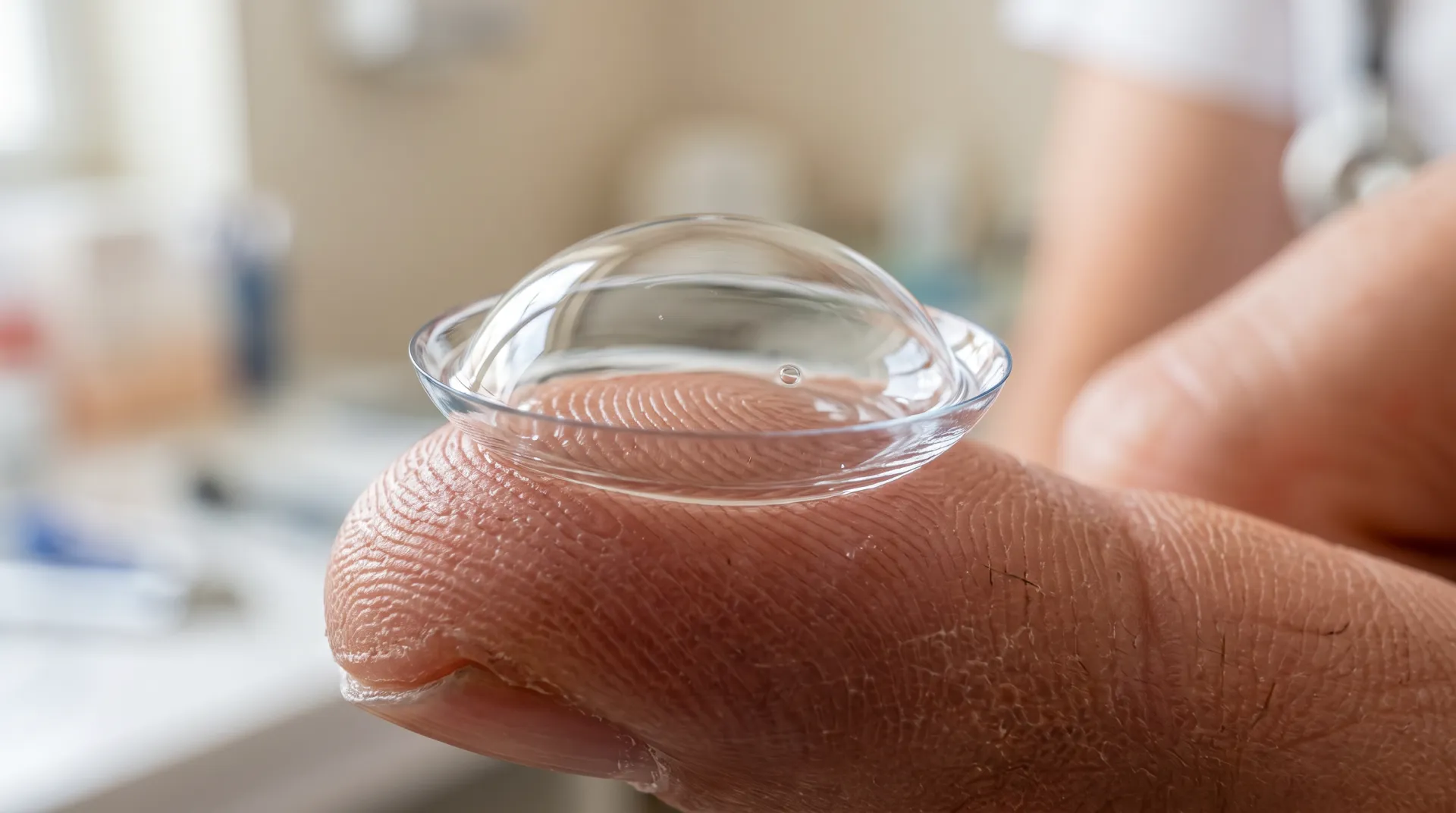
Scleral Lens Brands and Types: A Specialist's Comparison
There are over a dozen scleral lens designs on the market. The honest truth: for most keratoconus patients, outcomes are driven by fit quality — not brand. This guide explains what actually differs between designs so you can have an informed conversation with your specialist.
Medically Reviewed by Dr. Alexander Bonakdar, O.D.
The Three Sizes of Scleral Lenses
Scleral lenses are classified by diameter. Larger lenses vault more of the cornea, hold a bigger fluid reservoir, and provide more stability — but they are also harder to handle and insert.
Mini / Corneo-Scleral
14.5–15.8mm
Land partly on the cornea-scleral junction. Easier to handle. Best for mild–moderate keratoconus with smaller palpebral apertures.
Examples: Zen RC, MSD
Standard Scleral
15.5–18mm
Vault entirely over the cornea with a full fluid reservoir. The workhorse class for keratoconus, post-graft, and moderate ocular surface disease.
Examples: Zenlens, Onefit MED, Jupiter, Europa, ICD 16.5
Large / Full Scleral
18mm+
Maximum corneal clearance and fluid volume. Reserved for severe OSD, extreme scleral asymmetry, or cases that fail standard designs.
Examples: BostonSight SCLERAL, PROSE, EyePrint PRO
Brand-by-Brand Comparison
| Brand | Manufacturer | Diameter | Class | Key Features | Best For |
|---|---|---|---|---|---|
| Zenlens | Bausch + Lomb | 16.0 / 17.0mm | Standard | Prolate + oblate base curves, SmartCurve fitting, ECHO (2024) and CHROMA HOA variants | Keratoconus, post-graft, moderate OSD |
| Zen RC | Bausch + Lomb | 14.8 / 15.4mm | Mini | Smaller aperture, easier handling, reverse-geometry back surface | Mild–moderate KC, smaller palpebral apertures |
| Onefit MED | Blanchard / CooperVision | 15.6mm (16.0/16.4 rare) | Standard | 4 independently adjustable zones for precise scleral alignment | KC, irregular corneas, toric scleras |
| Jupiter | Visionary Optics | 15.0 / 18.0mm | Standard–Large | 5-curve / 3-zone design, two diameter options for staging | KC, OSD, GVHD |
| Europa | Visionary Optics | 15.0–18.0mm | Standard | Toric peripheral system for asymmetric scleras | KC with significant scleral toricity |
| ICD 16.5 | Paragon Vision Sciences | 16.5mm | Standard | Impression-free fitting, dual-axis peripheral curves | KC, pellucid marginal degeneration |
| MSD | Blanchard | 15.8mm | Standard | Simple 3-zone design, notch options for pingueculae | Moderate KC, easy-to-fit corneas |
| BostonSight SCLERAL | BostonSight | 14.5–19.0mm | Standard–Large | Widest diameter range available, profilometry-guided fitting | Severe OSD, GVHD, SJS, failed standard sclerals |
| EyePrint PRO | EyePrint Prosthetics | Custom (impression-based) | Custom | Exact scleral topography from physical impression mold | Failed standard sclerals, extreme irregularity |
| SynergEyes UltraHealth | SynergEyes | 14.5mm (hybrid) | Hybrid | Comfort of soft lens with optics of RGP, no fluid reservoir | Mild KC, RGP intolerance, active athletes |
Which Lens for Which Condition
Keratoconus (mild–moderate)
Any standard 15.5–18mm design (Zenlens, Onefit, Jupiter, Europa, ICD, MSD)
Keratoconus (advanced)
Zenlens 17mm, Jupiter 18mm, BostonSight SCLERAL 18mm
Post-corneal transplant
Zenlens, Onefit MED, Jupiter — any design with sufficient vault for irregular post-graft surface
Post-LASIK / post-RK ectasia
Standard 15.5–18mm designs; EyePrint PRO if standard sclerals fail
GVHD / SJS / severe dry eye
BostonSight SCLERAL 18mm, Jupiter 18mm — large reservoir for continuous hydration
Neurotrophic keratitis
BostonSight SCLERAL — corneal protection with maximal clearance
Extreme scleral asymmetry
EyePrint PRO (impression-based), Onefit MED (4-zone independent adjustment)
Hybrid preference (mild KC)
SynergEyes UltraHealth — easier handling, no insertion/removal saline step
Not Sure Which Scleral Lens You Need?
Dr. Bonakdar has fitted thousands of scleral lenses across every major design. Same-week evaluation available.
Does the Brand Actually Matter?
The honest answer: for most keratoconus patients, no. A systematic review of scleral lens outcomes confirms that visual acuity improvements are consistent across designs when the lens is fitted properly. A well-fitted 16mm Zenlens achieves the same BCVA as a well-fitted 16mm Onefit.
What does matter is your specialist's experience with a given design. A fitter who has managed 500 Zenlens patients will get a better result with Zenlens than with a design they have fitted 10 times — even if both designs are technically equivalent. Ask your specialist which design they fit most often and why.
Brand selection becomes clinically meaningful in two situations: severe ocular surface disease (where larger diameters and fluid volume matter) and extreme scleral asymmetry (where impression-based designs like EyePrint PRO can succeed after standard sclerals fail).
Cost and Insurance by Lens Class
| Class | Insurance |
|---|---|
| Standard scleral (Zenlens, Onefit, etc.) | V2531 — medical benefit for KC, vision benefit for visually necessary CL |
| BostonSight SCLERAL | V2531 (standard) or V2627 (OSD/prosthetic pathway) |
| EyePrint PRO | V2531 — prior auth strongly recommended |
| PROSE | Case-by-case; Medicare only under NCD 80.5 |
| Hybrid (SynergEyes) | Usually vision benefit; medical if KC diagnosis |
Standard scleral lenses at Keratoconus Vision Center are one global fee per eye, quoted at your evaluation, covering the fitting, corneal imaging, trial lenses, the final custom lenses, and all follow-up visits. We accept VSP and EyeMed vision plans, and all PPO plans are accepted. We verify your benefits for you before your visit, at no charge.
Fitting evaluation (CPT 92072) is billed separately and covered by some plans. See our insurance coverage guide for plan-by-plan details, or our cost breakdown for what to expect.
Find the Right Scleral Lens for Your Eyes
Dr. Bonakdar has fitted thousands of scleral lenses across every major design. Tell us about your situation and we'll recommend the best approach.
Schedule Your Expert Consultation
Fill out the form and our team will reach out within 1 business day.
Insurance Plans We Accept
We work with most major vision and medical insurance providers to maximize your benefits.
Vision Plans
- VSP (Vision Service Plan)
- EyeMed
- Davis Vision
- Spectera
- Superior Vision
- Avesis
Medical Plans
- Medicare
- Blue Shield of California
- Anthem Blue Cross
- United Healthcare
- Cigna
- Aetna
- Tricare
*Medical insurance is often used for medically necessary contact lenses.
CareCredit Financing
Make keratoconus treatment affordable with CareCredit. We offer 0% interest financing for 6- and 12-month plans on scleral lens fittings and other treatments. Apply in minutes — no impact to your credit score to check eligibility.
Lost or Broken Scleral Lens? Same-Day Help Available
Emergency scleral lens dispensing for keratoconus patients
If your scleral lens is lost, cracked, or damaged, you may be functionally unable to see. We understand the urgency. Dr. Alexander Bonakdar keeps diagnostic and loaner scleral lenses on-site and can often restore functional vision the same day while your custom replacement is being fabricated.
Emergency Scleral Lens Care & Insurance
- Office-hours and after-hours emergency care available — We accept VSP and EyeMed vision plans, and all PPO plans are accepted. We verify your benefits for you before your visit, at no charge.
- Free scleral lens starter kit — plunger, lens case and solution, plus insertion and removal training at no extra charge.
If your lens is cracked but still wearable, stop wearing it — a damaged edge can scratch the cornea and turn a lens replacement into a corneal injury.
Call Now: (949) 693-4900