Scleral Lens Insurance Coverage: Plan-by-Plan Guide (2026)
We accept VSP and EyeMed vision plans, and all PPO plans are accepted. Most medical insurance plans and employer vision plans cover scleral lenses when prescribed for keratoconus or ocular surface disease. Scleral lenses bill as medical devices under HCPCS code V2531, not routine vision — meaning they go through your medical benefit, not your vision rider. Coverage varies significantly by plan: VSP covers them with documentation, Medicare covers the fitting but not the lenses themselves, and most commercial plans require prior authorization.
Medically Reviewed by Dr. Alexander Bonakdar, O.D.
Most Covered
Medical Benefit
Scleral lenses for keratoconus are medically necessary — file under medical, not vision
V2531
HCPCS Billing Code
Scleral gas permeable contact lens — the primary code for insurance claims
We Handle It
Pre-Authorization
We verify your benefits and obtain pre-authorization before your fitting
Coverage by Insurance Plan
| Plan | Covers Scleral Lenses? | Key Requirement | Prior Auth |
|---|---|---|---|
| VSP | Yes | ≥2-line BCVA improvement vs glasses (since Jun 2024) | No, but documentation required |
| EyeMed | Yes | Severity criteria + documentation (tightened May 2024) | Varies by employer plan |
| Anthem BCBS (CA) | Yes | Keratoconus, keratitis sicca, aphakia listed | Typical |
| Blue Shield CA | Yes | Failed conventional correction | Plan-specific |
| UnitedHealthcare | Yes | Must go through medical network, not vision rider | Pre-determination recommended |
| Aetna | Fitting covered; materials plan-dependent | CPB 0126: fitting medically necessary | Yes |
| Cigna | Case-by-case under medical benefit | Documentation of medical necessity | Yes |
| Health Net / Medi-Cal | Yes | Prior auth through DHCS Vision Services Branch | Yes (mandatory) |
| MES (MESVision) | Yes | One pair fully covered with approval | Yes |
| Medicare | Fitting YES; lenses NO | Statutory refractive lens exclusion | N/A |
HCPCS and CPT Billing Codes
These are the codes used when billing insurance for scleral lenses and related services. Understanding them helps you verify your Explanation of Benefits (EOB) statements.
Qualifying Diagnoses for Medical Necessity
Insurance plans cover scleral lenses when prescribed for documented medical conditions — not routine vision correction. The following diagnoses qualify under Aetna CPB 0126 and equivalent policies from BCBS, UHC, Cigna, and most commercial plans:
Irregular Astigmatism and Corneal Ectasia
Corneal Stem Cell Deficiency
Neurotrophic (Anesthetic) Corneas
Severe Dry Eye
Corneal Disorders with Systemic Autoimmune Disease
Corneal Exposure
Other Qualifying Conditions
Why Insurance Classifies Scleral Lenses as Medically Necessary
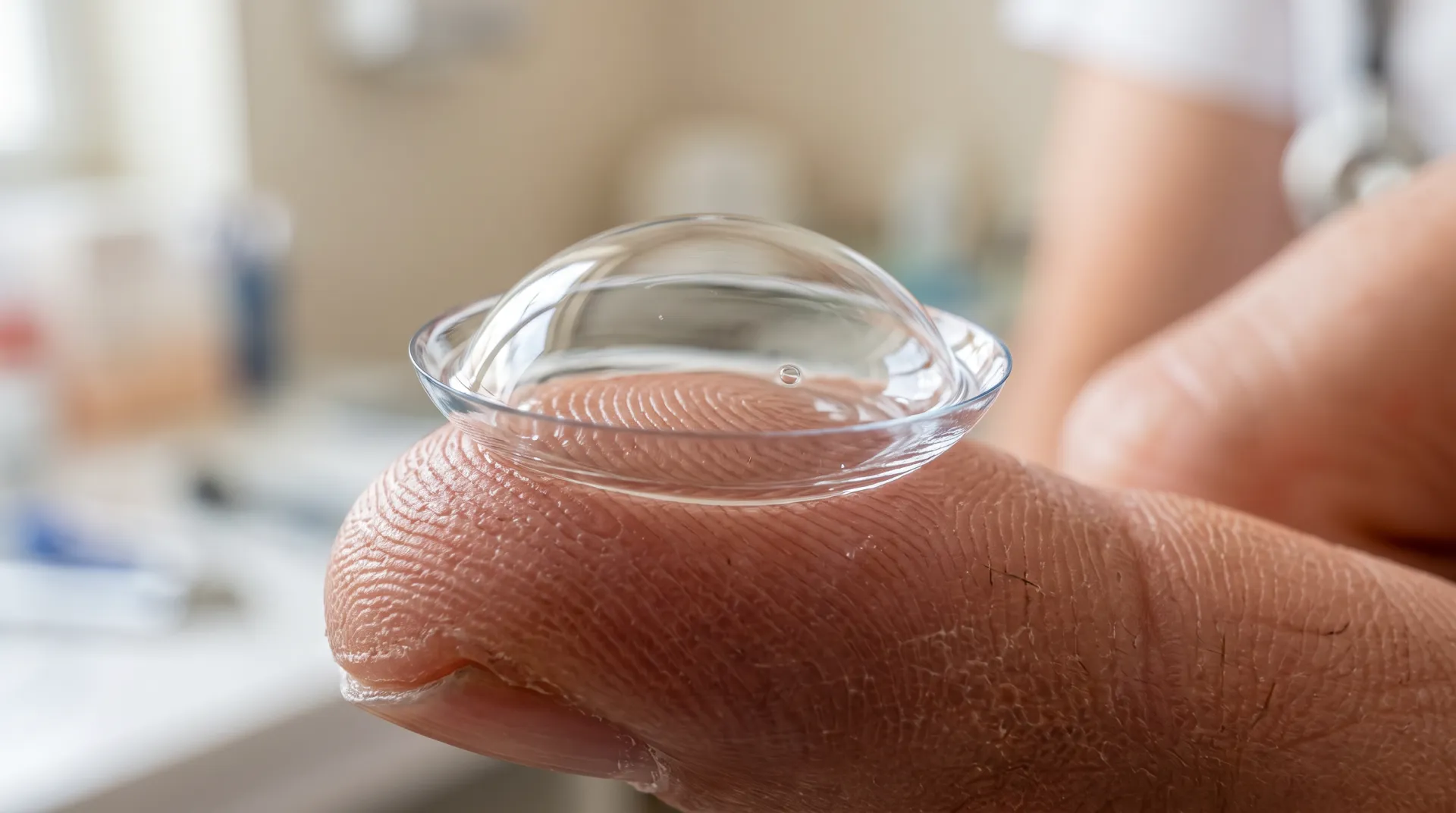
Scleral lenses vault over the cornea and rest on the sclera, creating a fluid reservoir of preservative-free saline that continuously bathes and protects the ocular surface. This makes them function as both a vision correction device and an ocular surface prosthesis — which is why insurance classifies them as medically necessary for these conditions rather than as elective vision correction.
We Verify Your Insurance Before Your Visit
No surprises. We confirm your scleral lens coverage and obtain pre-authorization before starting.
How We Handle Insurance for You
Navigating insurance for specialty contact lenses can be confusing. Our office handles the entire process — you do not need to call your insurance company, figure out billing codes, or submit claims yourself.
Before your fitting appointment, we verify your specific benefits, determine your out-of-pocket responsibility, and obtain any required pre-authorization. If a claim is denied, we handle the appeal with supporting clinical documentation.
- 1We verify your medical insurance benefits for scleral lens coverage
- 2We submit corneal topography and visual acuity documentation
- 3We obtain pre-authorization before scheduling your fitting
- 4We tell you your exact out-of-pocket cost before you commit
For cost details including fitting fees and replacement pricing, see our complete scleral lens cost guide.
Insurance Plans We Accept
We work with most major vision and medical insurance providers to maximize your benefits.
Vision Plans
- VSP (Vision Service Plan)
- EyeMed
- Davis Vision
- Spectera
- Superior Vision
- Avesis
Medical Plans
- Medicare
- Blue Shield of California
- Anthem Blue Cross
- United Healthcare
- Cigna
- Aetna
- Tricare
*Medical insurance is often used for medically necessary contact lenses.
CareCredit Financing
Make keratoconus treatment affordable with CareCredit. We offer 0% interest financing for 6- and 12-month plans on scleral lens fittings and other treatments. Apply in minutes — no impact to your credit score to check eligibility.
Medical Insurance vs. Vision Insurance: Which One Pays?
Vision Insurance
Vision plans (VSP, EyeMed, MES) cover scleral lenses as “visually necessary contact lenses” when glasses cannot achieve adequate visual acuity. These plans typically cover lens materials with a copay and have annual maximums.
Best for: keratoconus patients with vision-only coverage
Medical Insurance
Medical plans (Anthem, UHC, Aetna, Cigna) cover scleral lenses as therapeutic medical devices — particularly for ocular surface disease (GVHD, SJS, neurotrophic keratitis, severe dry eye). Medical coverage is typically broader with higher reimbursement rates.
Best for: OSD patients and those with both medical and vision benefits
Aetna: The Nuance That Matters
Under Aetna Clinical Policy Bulletin 0126, scleral lenses used therapeutically for ocular surface disease (as a “liquid bandage”) are covered even under plans that exclude contact lenses. However, plans with contact lens exclusions do not cover sclerals prescribed solely to correct keratoconus astigmatism without an OSD component. This distinction matters — if your Aetna plan has a CL exclusion, your diagnosis determines coverage.
Understanding the Codes Behind Your Claim
Knowing which billing codes apply to your situation helps you verify your Explanation of Benefits and catch underpayments. Reimbursement varies by payer and plan — the amounts below are representative ranges, not guarantees.
Scleral gas permeable contact lens (per lens)
The primary code for scleral lenses. Identifying the manufacturer and brand in Box 19 of the claim can improve reimbursement — omitting it may cause the claim to be downgraded to the lower-paying V2599 code.
Contact lens, other type
A catch-all code sometimes used when V2531 documentation is incomplete. Reimbursement is significantly lower. Ensure your claim specifies V2531 with the lens brand.
Scleral cover shell (prosthetic)
Used when the scleral device treats an NCD 80.5-qualifying condition — specifically, severe dry eye where the lens substitutes for lacrimal function. This is the code that opens the narrow Medicare coverage pathway for scleral lens materials.
Contact lens fitting for keratoconus (initial)
Covers the initial fitting evaluation for keratoconus patients. This code is payable by Medicare and most commercial plans. Follow-up fittings bill under different evaluation codes.
Contact lens fitting for ocular surface disease
The fitting code for therapeutic/bandage lens applications — GVHD, SJS, neurotrophic keratitis, and other OSD indications. Used instead of 92072 when the primary indication is ocular surface protection rather than vision correction.
Scleral lens, liquid bandage device
Supplemental code used alongside V2531 or V2627 to document the therapeutic function of the lens as an ocular surface prosthesis.
How Our Office Handles Medical Scleral Lens Billing
Due to the high cost of scleral lens materials and the complexity of medical billing for specialty devices, our office does not accept assignment on medical scleral lens claims. Here is how the process works:
You pay at time of service
Scleral lens materials are paid in full at the time of fitting. This covers the lab-fabricated custom lenses, which cannot be returned or reused.
We prepare and submit your claim
Our billing team prepares the complete insurance claim package, including corneal topography maps, best-corrected visual acuity (BCVA) documentation, and a letter of medical necessity. We submit this directly to your insurer.
Your insurer reimburses you directly
The insurance company processes the claim and sends reimbursement directly to you, the patient. The amount depends on your plan's coverage, deductible, and copay structure.
We handle prior authorization and appeals
If your plan requires prior authorization, we obtain it before your fitting. If a claim is denied, we manage the appeal process — including gathering additional documentation and contacting the medical director if needed.
Why we do not accept assignment: Custom scleral lenses require significant upfront lab and material costs that cannot be recovered if insurance reimbursement is delayed or denied. By handling billing on your behalf while you pay at the time of service, we can offer the same quality of care without the uncertainty of insurance timelines affecting your treatment.
Get Your Insurance Verified
We check your medical insurance benefits for scleral lens coverage before your first visit — no surprises.
Or call: (949) 693-4900
Schedule Your Expert Consultation
Fill out the form and our team will reach out within 1 business day.
Last reviewed July 2026 by Dr. Alexander Bonakdar, OD
Lost or Broken Scleral Lens? Same-Day Help Available
Emergency scleral lens dispensing for keratoconus patients
If your scleral lens is lost, cracked, or damaged, you may be functionally unable to see. We understand the urgency. Dr. Alexander Bonakdar keeps diagnostic and loaner scleral lenses on-site and can often restore functional vision the same day while your custom replacement is being fabricated.
Emergency Scleral Lens Care & Insurance
- Office-hours and after-hours emergency care available — We accept VSP and EyeMed vision plans, and all PPO plans are accepted. We verify your benefits for you before your visit, at no charge.
- Free scleral lens starter kit — plunger, lens case and solution, plus insertion and removal training at no extra charge.
If your lens is cracked but still wearable, stop wearing it — a damaged edge can scratch the cornea and turn a lens replacement into a corneal injury.
Call Now: (949) 693-4900