Scleral Lenses for Post-LASIK and Radial Keratotomy Patients
When refractive surgery leaves behind an irregular cornea, glasses and standard contacts cannot give you sharp, stable vision. Scleral lenses create a new optical surface — vaulting completely over the corneal irregularities that are making your vision blurry, distorted, or unstable.
What Patients Say After Getting Scleral Lenses
"I got my life back. I was told I'd just have to live with the blurry vision."
"I can drive at night again for the first time in years. The halos are completely gone."
"I wake up, put in my scleral lenses, and my vision is perfect all day. My prescription doesn't shift like it used to."
"I was skeptical — I thought it was just contacts. They are completely different from anything I've ever worn."
Who Benefits Most from Scleral Lenses
- ✓
Post-LASIK ectasia
Cornea weakened and deformed after LASIK, causing progressive vision distortion
- ✓
Irregular LASIK ablation
Uneven laser treatment creating higher-order aberrations glasses can't correct
- ✓
Long-term RK patients
Hyperopic shift, diurnal variation, and irregular incision healing
- ✓
Chronic post-LASIK dry eye
Fluid reservoir provides continuous moisture throughout the day
- ✓
Post-RK cataract patients
Residual irregular astigmatism after cataract surgery in an RK eye
How Scleral Lenses Work — and Why They Succeed Where Others Fail
The physics of scleral lenses make them uniquely effective for post-surgical irregular corneas.
Standard Lenses: Follow the Problem
Glasses
Correct for a single prescription — useless when that prescription shifts 3 diopters between morning and afternoon (RK diurnal variation). Cannot correct higher-order aberrations causing halos and starbursts.
Soft Contact Lenses
Drape over and conform to the irregular corneal surface, inheriting its distortions. They correct the refractive error but not the irregularity — providing only modest improvement for post-LASIK or RK patients.
Standard RGP Lenses
Sit directly on the cornea — often uncomfortable on irregular post-surgical surfaces, and their small size may not fully vault the treatment zone of an RK or LASIK cornea.
Scleral Lenses: Bypass the Problem
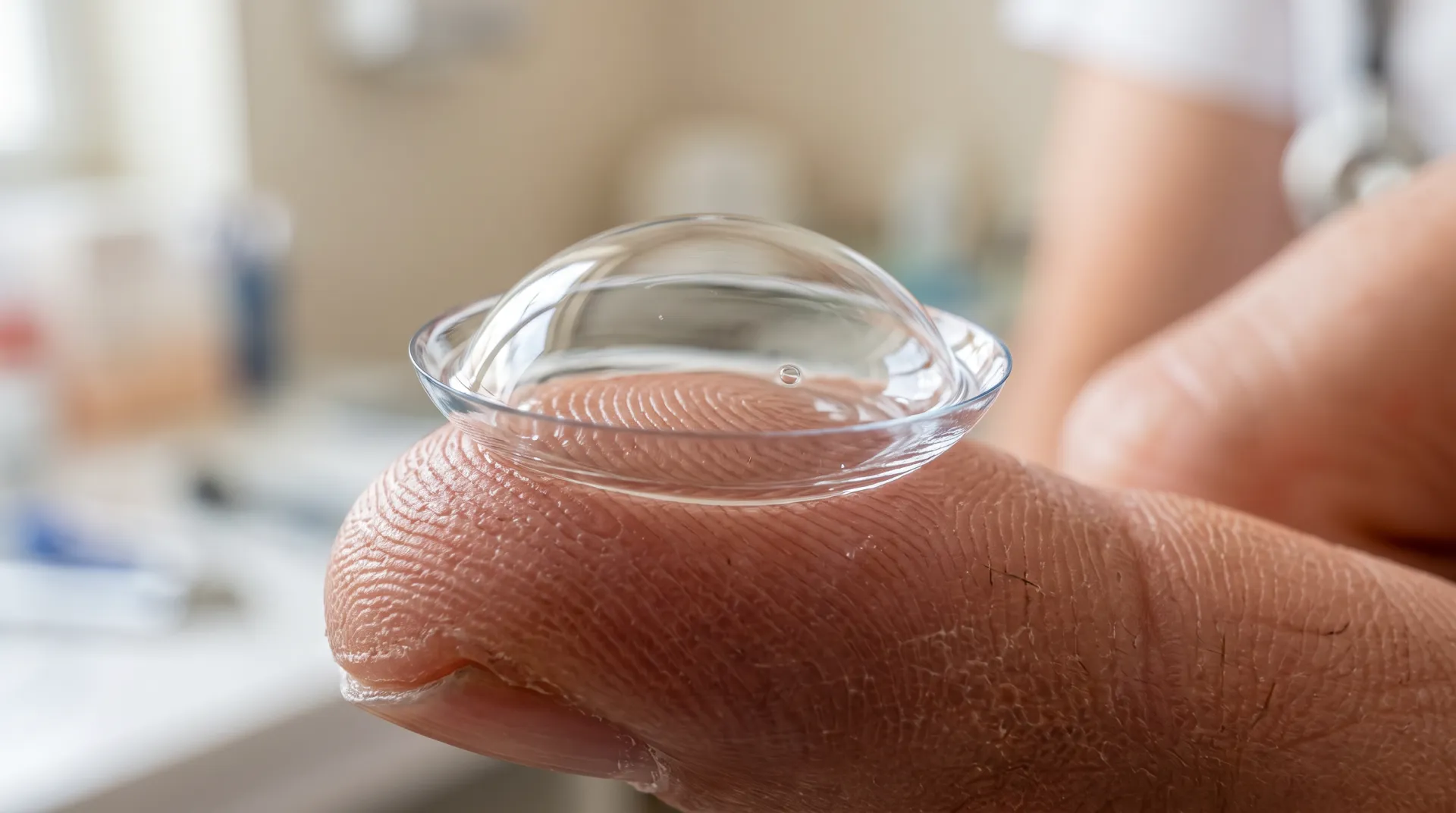
A scleral lens is a large-diameter rigid lens that spans the entire cornea, resting gently on the sclera. The dome-shaped space between the lens and cornea fills with preservative-free saline.
Light entering the eye refracts through the smooth front surface of the lens — not the irregular cornea. The saline behind the lens has nearly the same refractive index as the cornea, so the corneal irregularity is optically neutralized.
The result:
The Fitting Process for Post-Surgical Patients
Fitting scleral lenses for post-LASIK or RK corneas requires specialized expertise and typically 2–4 visits. The goal is precision — a lens that fits properly is comfortable, provides excellent vision, and maintains corneal health.
Step 1
Comprehensive Corneal Evaluation
Corneal topography and tomography map the shape of your cornea in detail. For post-LASIK or RK patients, this reveals the specific irregularities that need to be vaulted, the degree of ectasia if present, and the available area of scleral tissue for lens landing.
Step 2
Trial Lens Selection
Based on your topography, an appropriate trial scleral lens is selected from our fitting set. Parameters include diameter (16–24mm), base curve, vault height, and landing zone geometry. Post-LASIK and RK corneas often require custom lens designs not available in standard fitting sets.
Step 3
Fit Assessment & Refraction
With the trial lens in place, we assess the clearance over the cornea (ensuring adequate vault without excessive saline thickness), the landing on the sclera (no pressure on the limbus), and centration. Refraction over the trial lens determines the final prescription.
Step 4
Lens Delivery & Training
Custom lenses are ordered and returned in 1–3 weeks. We teach insertion and removal techniques, care protocols, and troubleshooting. Follow-up visits at 1 week and 1 month confirm fit, vision, and corneal health.
Insurance Coverage for Scleral Lenses
When scleral lenses are medically necessary due to irregular astigmatism, post-surgical corneal complications, or documented failure of standard contact lenses, they are often covered under medical insurance — not just vision plans. Most major medical insurers recognize scleral lenses as medically necessary for post-LASIK ectasia, RK complications, and similar diagnoses.
We assist with pre-authorization documentation and work with your insurance to maximize coverage. See our full scleral lenses cost and insurance guide.
35+ Years Fitting Specialty Lenses for Complex Corneal Cases
Dr. Alexander Bonakdar has specialized in scleral and specialty contact lens fitting for over three decades. His practice receives referrals from CHOC (Children's Hospital of Orange County) and UCI Medical Center for patients who cannot be managed with standard correction.
Post-LASIK and RK patients represent a significant portion of our complex lens fitting caseload. We understand the frustration of these patients — many of whom have been told by multiple providers that nothing more can be done — and the profound difference that well-fitted scleral lenses make.
Our Specialty Lens Capabilities
- ✓Scleral lens fitting (16–24mm diameter)
- ✓Mini-scleral and corneoscleral lenses
- ✓Custom scleral designs for highly irregular corneas
- ✓Corneal topography and wavefront analysis
- ✓Post-cataract scleral lens fitting for RK patients
- ✓Dry eye evaluation and management
Frequently Asked Questions
How do scleral lenses work for LASIK or RK complications?
Scleral lenses are large-diameter rigid gas-permeable lenses that rest on the sclera and vault completely over the cornea. The fluid-filled space between the lens and cornea creates a smooth, regular refracting surface — bypassing the corneal irregularities created by LASIK or RK. Light refracts through the smooth front surface of the lens rather than the irregular cornea.
Will scleral lenses be comfortable to wear all day?
Most patients are surprised by the comfort. Because scleral lenses rest on the insensitive scleral tissue (not the sensitive cornea), they are often more comfortable than standard contacts. The fluid reservoir also provides continuous moisture — ideal for post-LASIK dry eye. Most patients wear them 12–14 hours per day.
How long does fitting take for post-LASIK patients?
Post-LASIK and RK fitting typically requires 2–4 visits over several weeks. We map the corneal surface with topography, select trial lenses based on corneal shape, assess the vault and fit, and refine the prescription. The complexity of your corneal irregularity determines the number of visits.
Does insurance cover scleral lenses for LASIK or RK complications?
In many cases, yes. When scleral lenses are medically necessary for irregular astigmatism, corneal ectasia, or documented failure of standard correction, they are often covered under medical insurance. We assist with pre-authorization documentation and insurance verification.
Related Conditions We Treat
Schedule a Scleral Lens Evaluation
Most post-LASIK and RK patients are seen within the same week. Bring any prior topography or records if available — but we can start fresh with our own evaluation.
Schedule Your Expert Consultation
Fill out the form and our team will reach out within 1 business day.