Keratoconus: Do You Need an Ophthalmologist, or a Specialty Lens Optometrist?
Dr. Alexander Bonakdar is an optometrist (O.D.), not an ophthalmologist. Keratoconus surgery belongs to ophthalmology. Diagnosing keratoconus, tracking it with corneal mapping, and fitting lenses to an irregular cornea is a subspecialty of optometry — and it is the part most patients actually need first.
The short answer
Most people searching for a “keratoconus ophthalmologist” are not actually asking for a surgeon. They are asking for someone who works on keratoconus specifically, rather than a general eye exam that ends in a referral.
That care splits cleanly. If your cornea needs a procedure — cross-linking, ring segments, a transplant — that is done by an ophthalmologist, an M.D. surgeon. If your cornea needs to be measured, watched, and corrected — imaging, progression tracking, and a lens built for an irregular surface — that is a subspecialty of optometry.
You don’t have to pick the right specialist type before your first appointment. Come in, get the corneal map, and leave knowing exactly which kind of care your eyes need.
Who does what in keratoconus care
Neither role replaces the other. Most keratoconus patients are managed by an optometrist and see a corneal surgeon only when a procedure is indicated.
| Part of keratoconus care | Corneal ophthalmologist (M.D.) | Specialty lens optometrist (O.D.) |
|---|---|---|
| Diagnosing keratoconus from corneal imaging | Yes | Yes — this is routine optometric corneal work |
| Corneal topography and tomography to map the cornea | Yes | Yes — performed and interpreted in-office |
| Tracking progression across serial scans | Yes | Yes — usually the doctor who sees you most often |
| Corneal cross-linking (CXL) | Yes — a surgical procedure | No — referred out and co-managed |
| Intrastromal ring segments, corneal transplant | Yes — a surgical procedure | No — referred out and co-managed |
| Fitting scleral lenses on an irregular cornea | Rarely — usually referred to a specialty lens practice | Yes — this is the subspecialty |
| Long-term lens care, refits, and monitoring | Rarely | Yes — ongoing |
Dr. Bonakdar practices the right-hand column. He does not perform surgery.
Why ophthalmology practices refer lenses out
Fitting a scleral lens on a keratoconic cornea is not a smaller version of surgery. It is a separate skill, built on volume: reading elevation data, choosing a starting lens, judging vault and edge alignment, and refining across follow-ups until the eye is comfortable all day.
So when an ophthalmology practice or a children’s hospital has a complex cornea that needs lenses rather than an operating room, the case goes to a specialty lens optometrist. That is the referral pattern behind CHOC and UCI sending complex corneal referrals here.
It also runs the other way. When the corneal map shows the cornea is changing, Dr. Bonakdar refers to a corneal surgeon — that is the appropriate next step, not a failure of the lens plan.
What the first visit settles
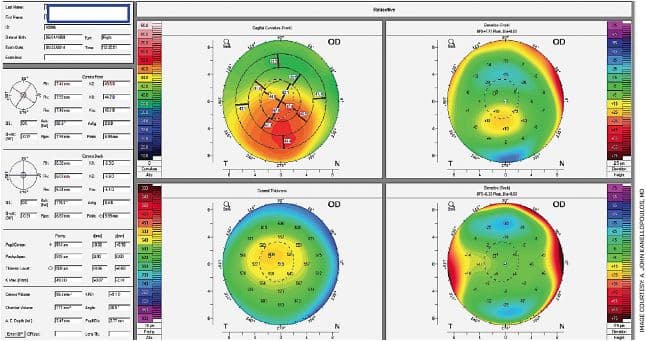
Your cornea gets mapped
Corneal topography and tomography measure the shape and thickness of each cornea. This is the objective record everything else is decided from.
You find out whether it is progressing
Keratoconus is a progressive condition, and it tends to move fastest in the teens and twenties. If there are prior scans, they are compared. If not, the map becomes your baseline and a follow-up interval is set.
You are told at that visit if surgery is on the table
If the findings point toward cross-linking, Dr. Bonakdar says so at the first appointment and refers you to a corneal surgeon, rather than sending you through a series of visits first. Cross-linking is intended to halt progression — it does not reverse changes already present, which is why the timing of that referral matters.
The lens question gets answered honestly
If glasses or standard lenses still serve you well, that is what you are told. If the cornea has become irregular enough that only a lens vaulting over it will give you a clear image, scleral lens options are discussed with real numbers attached.
Get the corneal map first, then decide
Same-week appointments in Santa Ana. You see Dr. Bonakdar directly, never a trainee.
Dr. Alexander Bonakdar, O.D.
Keratoconus Vision Center, Santa Ana, Orange County. Optometrist — non-surgical keratoconus management and specialty lens fitting.
- Doctor of Optometry, Illinois College of Optometry
- Bascom Palmer trained
- 5,000+ keratoconus cases
- 35+ years in practice in Orange County
- CHOC and UCI send complex corneal referrals here
- 4.9 stars across 133 Google reviews
Dr. Bonakdar is a Doctor of Optometry. He is not an ophthalmologist and does not perform surgical procedures.
Cost and how it is billed
Scleral lens fitting is $2,500 to $8,000 per eye. That is a single global fee — the fitting itself, the corneal imaging, trial lenses, your final lenses, and all follow-up visits are inside it. Where an eye falls in that range depends on how irregular the cornea is and how much lens design work it takes.
The billing mechanism is worth understanding, because it is the part people get wrong. Keratoconus is a medical diagnosis, so medically necessary contact lenses are billed to your medical insurance — not to a routine vision plan.
Whether that produces coverage is a separate question. Some plans cover a portion of a medically necessary lens fitting and some do not, and the terms vary substantially plan to plan. We verify your specific benefits before the fitting begins, so you know the number before you commit to it.
Read the full insurance guideInsurance Plans We Accept
We work with most major vision and medical insurance providers to maximize your benefits.
Vision Plans
- VSP (Vision Service Plan)
- EyeMed
- Davis Vision
- Spectera
- Superior Vision
- Avesis
Medical Plans
- Medicare
- Blue Shield of California
- Anthem Blue Cross
- United Healthcare
- Cigna
- Aetna
- Tricare
*Medical insurance is often used for medically necessary contact lenses.
CareCredit Financing
Make keratoconus treatment affordable with CareCredit. We offer 0% interest financing for 6- and 12-month plans on scleral lens fittings and other treatments. Apply in minutes — no impact to your credit score to check eligibility.
Common questions
Is Dr. Bonakdar an ophthalmologist?
No. Dr. Alexander Bonakdar is an optometrist (O.D.), not an ophthalmologist (M.D.). He does not perform surgery. His practice is limited to the non-surgical side of keratoconus care: diagnosis, corneal imaging, tracking progression over time, and fitting scleral and other specialty lenses on irregular corneas. When a patient needs a surgical procedure such as corneal cross-linking or a corneal transplant, he refers to and coordinates with a corneal surgeon.
Do I need an ophthalmologist or an optometrist for keratoconus?
It depends on what your cornea needs, and that is usually not knowable before the first exam. Surgical procedures for keratoconus — corneal cross-linking, intrastromal ring segments, corneal transplant — are performed by ophthalmologists. Diagnosing keratoconus, mapping the cornea, documenting whether it is progressing, and fitting a lens to an irregular cornea are a subspecialty of optometry. Many keratoconus patients end up needing both, in that order. You do not have to choose correctly before you book.
Why do ophthalmology practices refer patients to a specialty lens optometrist?
Because fitting a scleral lens on an irregular cornea is a distinct clinical skill built on case volume, not on surgical training. When an ophthalmology practice or a children's hospital has a cornea that needs lenses rather than a scalpel, the referral goes to a specialty lens optometrist. CHOC and UCI send complex corneal referrals to Dr. Bonakdar for exactly this reason.
Can an optometrist diagnose keratoconus?
Yes. Keratoconus is diagnosed with corneal imaging — topography and tomography that map the shape and thickness of the cornea — and that imaging is performed and interpreted in optometric practice routinely. The same imaging is what documents whether the cornea is changing over time, which is the finding that determines whether a surgical referral for cross-linking is warranted.
What happens if the exam shows I need surgery?
Dr. Bonakdar tells you at that first visit rather than scheduling you for a series of follow-ups first. If the corneal map shows progression, he refers you to a corneal surgeon for cross-linking evaluation and coordinates the care around it, including the lens fitting that typically follows. Cross-linking is intended to halt progression; it does not reverse corneal changes that have already occurred, which is why timing matters.
How much do scleral lenses cost, and does insurance cover them?
Scleral lens fitting at Keratoconus Vision Center is $2,500 to $8,000 per eye. That is one global fee covering the fitting, corneal imaging, trial lenses, the final lenses, and all follow-up visits. Because keratoconus is a medical diagnosis, medically necessary contact lenses are billed to your medical insurance rather than to a routine vision plan. Some plans cover a portion; coverage varies substantially by plan, so we verify your specific benefits before the fitting begins.
How soon can I be seen in Orange County?
Same-week appointments are typically available at Keratoconus Vision Center in Santa Ana. Waits for a specialty corneal appointment often run weeks to months at large academic centers, which is a function of teaching-hospital volume. You are seen by Dr. Bonakdar directly at every visit — never a trainee.
Start with the corneal map
One appointment tells you whether your keratoconus needs a surgeon, a lens, or just monitoring. Same-week availability. We verify your insurance before your visit.
Or call: (949) 693-4900
Schedule Your Expert Consultation
Fill out the form and our team will reach out within 1 business day.
Last reviewed August 2026 by Dr. Alexander Bonakdar, O.D.