
Keratoconus Treatment Orange County — 5,000+ Cases, Same-Week Appointments
Most clinics see 10 keratoconus patients a year. We’ve treated 5,000+. Same-week appointments near you.
Why Choose Our Keratoconus Specialist
Most eye doctors see 5–10 keratoconus patients a year. We've treated over 5,000. That volume of experience means faster diagnosis, better lens fits, and fewer return visits.
Keratoconus Expertise
- Bascom Palmer trained — the #1 eye hospital in the U.S.
- Referral center for CHOC & UCI Medical Center
- Advanced corneal topography and tomography on-site
- Full-spectrum keratoconus care: lenses, CXL coordination, monitoring
Patient Experience
- Same-week appointments — no 3-month wait lists
- See the specialist directly, not residents or fellows
- Insurance accepted — VSP, EyeMed and all PPO plans
- Free scleral lens starter kit and insertion training
- One location for diagnosis, lenses, and ongoing care
Not Sure If It's Keratoconus?
Answer six questions about how your vision actually behaves — the ghosting, the night glare, the prescription that keeps changing — and get a straight read on whether a keratoconus evaluation is worth your time. About two minutes. Dr. Bonakdar reviews every result himself.
Rather just talk it through? Call (949) 693-4900 — same-week appointments.
Keratoconus Treatment Options
Your keratoconus treatment plan depends on the stage and progression of your condition. We offer the full range of non-surgical options.
Scleral Lens Fitting
Custom-designed scleral lenses vault over the irregular cornea, restoring clear, comfortable vision. Our keratoconus specialist has completed 5,000+ fittings.
Cross-Linking Coordination
Corneal cross-linking (CXL) stops keratoconus progression. We coordinate CXL with top surgeons and manage your vision before and after the procedure.
Keratoconus Monitoring
Advanced corneal topography tracks your keratoconus progression with micron-level precision. Early detection means earlier intervention.
Post-Surgical Vision Rehabilitation
After corneal transplant or cross-linking, specialty lenses restore functional vision. Our keratoconus specialist fits lenses over complex post-surgical corneas.
Keratoconus Stages: Early, Moderate & Advanced
Keratoconus is generally classified into four stages based on how steep and thin the cornea has become. Knowing your stage guides the right keratoconus treatment — from monitoring and cross-linking to scleral lenses.
Early (Forme Fruste)
Subtle corneal steepening detected on topography. Vision is often still correctable with glasses or soft lenses. Cross-linking is most effective when started here.
Moderate
Increasing irregular astigmatism and corneal thinning. Glasses no longer give crisp vision — specialty or scleral lenses are usually introduced.
Advanced
Significant cone formation and thinning. Scleral lenses become the primary way to restore clear, comfortable vision over the irregular cornea.
Severe
Pronounced thinning and scarring. Custom scleral lenses still help most patients; a minority may need a corneal transplant followed by lens fitting.
Not sure which stage you're in? Read our guide to the four stages of keratoconus, or explore scleral lenses for keratoconus.
Advanced Keratoconus Diagnostics
Keratoconus changes over time. Our diagnostic technology tracks your corneal shape visit-to-visit, detecting progression early so we can act before your vision deteriorates further.
- Corneal Topography — maps the front surface curvature
- Corneal Tomography — full anterior and posterior analysis
- Pachymetry — measures corneal thickness at every point
- Anterior Segment OCT — cross-section imaging of the cornea
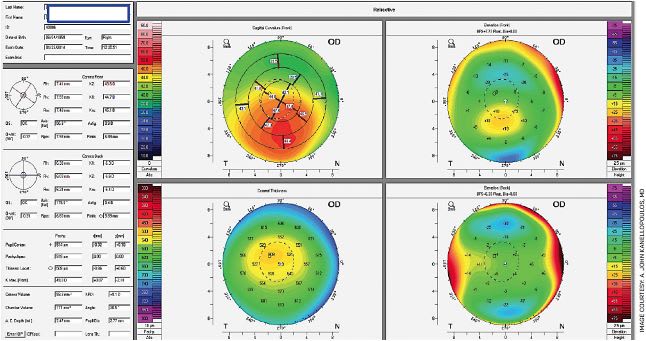
Corneal Topography: Tracking Keratoconus Progression Over Time
See the Difference Treatment Makes
Keratoconus distorts your cornea. Scleral lenses create a new optical surface — see how treatment restores clear vision.

Dr. Alexander Bonakdar, O.D.
Keratoconus Specialist
35+ Years Clinical Experience
Dr. Bonakdar is an Orange County keratoconus specialist who has dedicated his career to treating patients with keratoconus and corneal disease. With over 5,000 keratoconus cases treated, he provides expert corneal evaluation, scleral lens fitting, cross-linking coordination, and ongoing keratoconus management at the Keratoconus Vision Center in Santa Ana, California.
The practice is a referral center for CHOC (Children's Hospital of Orange County) and UCI Medical Center — hospitals send their most complex keratoconus cases to Dr. Bonakdar when they need a specialist with hands-on experience.
Insurance Plans We Accept
We work with most major vision and medical insurance providers to maximize your benefits.
Vision Plans
- VSP (Vision Service Plan)
- EyeMed
- Davis Vision
- Spectera
- Superior Vision
- Avesis
Medical Plans
- Medicare
- Blue Shield of California
- Anthem Blue Cross
- United Healthcare
- Cigna
- Aetna
- Tricare
*Medical insurance is often used for medically necessary contact lenses.
CareCredit Financing
Make keratoconus treatment affordable with CareCredit. We offer 0% interest financing for 6- and 12-month plans on scleral lens fittings and other treatments. Apply in minutes — no impact to your credit score to check eligibility.
Keratoconus Specialist Serving All of Orange County
Patients travel from across Southern California for keratoconus treatment. Located in Santa Ana with easy access from Irvine, Newport Beach, Anaheim, Huntington Beach, Costa Mesa, Tustin, and surrounding communities.
Keratoconus Treatment FAQs
Common questions about keratoconus stages, cross-linking, scleral lenses, and insurance.
Book Your KC Consultation
Don't wait for your keratoconus to progress. Schedule your evaluation with Orange County's most experienced keratoconus specialist. Same-week appointments available.